Phone: +254 700 524589 | +254 782 524589 Email: [email protected]


Introduction: Workforce Change Doesn’t Wait for Anyone
Mergers. Retrenchments. Digital transformation. Culture overhauls. Rapid growth. Whatever the trigger, workforce change is one of the most complex and high-stakes challenges any organisation can face — and how it is handled determines whether a business emerges stronger or fractured.
At the centre of every successful workforce transition is a competent HR professional. But not just any HR professional. Increasingly, organisations are discovering that certified HR professionals — specifically those holding the Certificate in Human Resource Practice (CHRP) — consistently deliver better outcomes during periods of change.
This blog explores why CHRP-certified professionals lead workforce change more effectively, what the certification actually means, and why it matters whether you are an HR practitioner, an aspiring HR professional, or a business leader looking to build a resilient team.
What Is CHRP and Who Awards It?
The Certificate in Human Resource Practice (CHRP) is a professional qualification awarded by Human Resource Management Professionals Examinations Board (HRMPEB). — the statutory body mandated to regulate and develop the HR profession in Kenya under the Human Resource Management Professionals Act.
CHRP is designed to produce practitioners who are not just administratively capable but strategically equipped. Here are the six core competency areas the certification covers:
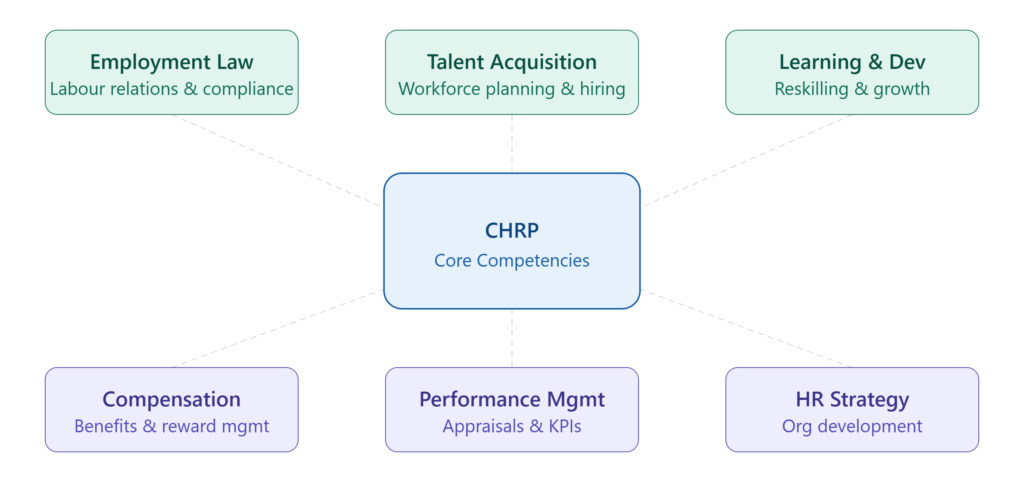
To earn CHRP, candidates must complete prescribed coursework, pass structured assessments, and demonstrate applied competence. This is not a participation certificate — it is an earned credential that signals a measurable level of knowledge and professional readiness.
In Kenya and increasingly across East Africa, CHRP is recognised as the baseline qualification for professional HR practice, with the Higher Diploma in Human Resource Management (HDHRM) building on its foundation.
The Gap Between Certified and Uncertified HR
Here is the honest reality: many organisations across Africa have HR functions staffed by well-meaning professionals who lack formal HR training. Some come from administration, others from operations, and some simply grew into the role over time. They may be hardworking and experienced — but experience without structured knowledge has limits.
That limit becomes painfully visible during workforce change.
A certified HR professional brings structured frameworks to situations that would otherwise be navigated by instinct. Where an uncertified practitioner might handle a redundancy based on what feels fair, a CHRP holder knows the exact legal obligations under the Employment Act (Cap 226) — including notice periods, terminal benefits, and the requirement for consultation. The difference between those two approaches can mean the difference between a smooth transition and an employment tribunal.
Beyond compliance, certified HR professionals bring a people-strategy lens to change. They understand how to sequence communication, manage survivor syndrome among retained employees, and rebuild trust after disruption.
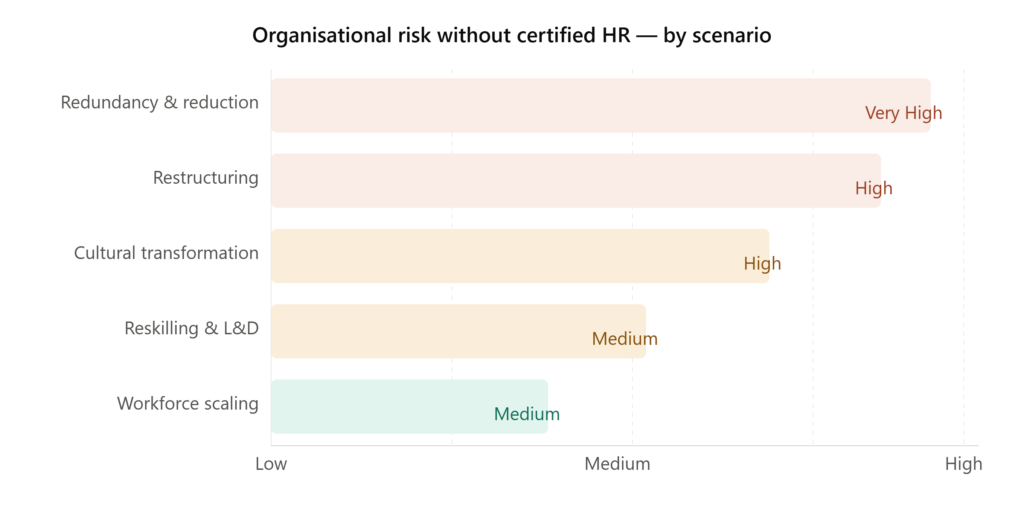
5 Workforce Change Scenarios Where CHRP Makes the Difference
1. Organisational Restructuring — When leadership decides to flatten a hierarchy, merge departments, or eliminate redundant roles, a CHRP-certified professional can develop a legally compliant plan, facilitate objective job evaluation, manage the consultation process, and design communication cascades that maintain morale. Without this expertise, restructuring triggers grievances, legal challenges, and talent exodus.
2. Rapid Workforce Scaling — Fast-growing organisations face the challenge of scaling quickly without diluting culture or quality. CHRP-certified professionals understand workforce planning methodologies, competency-based recruitment, and structured onboarding.
3. Digital Transformation and Reskilling — Certified HR professionals are trained in learning needs analysis and adult learning principles — enabling them to design reskilling programmes that are practical and measurable, not generic training people forget by the following week.
4. Cultural Transformation — CHRP-certified professionals understand models like Kotter, Lewin, and Prosci ADKAR, plus the tools — engagement surveys, focus groups, values workshops, leadership alignment sessions — needed to navigate culture shift systematically.
5. Workforce Reduction and Redundancy — CHRP holders are trained in the legal, ethical, and psychological dimensions of workforce reduction. They know how to structure a fair selection matrix, calculate terminal benefits, and protect the organisation from unfair dismissal claims.
Why Organisations Trust Certified HR Professionals
Beyond individual competence, CHRP certification signals something important to employers and employees alike: accountability.
IHRM-registered HR professionals are bound by a code of professional ethics and are subject to disciplinary processes if they breach it. This creates a layer of governance that is simply absent when HR is practised without professional accreditation.
From an organisational risk perspective, this matters deeply. In an era where employment disputes, labour strikes, and regulatory scrutiny are increasingly common in Kenya’s corporate landscape, having a certified HR professional in a leadership role is a risk mitigation strategy in itself.
There is also a credibility dividend. Employees and managers respond differently to an HR professional who can back up their decisions with law, data, and professional standards. That credibility accelerates buy-in during change — which is the single biggest determinant of whether a change initiative succeeds or stalls.
The Career Case for CHRP Certification
For HR practitioners, the numbers tell a clear story. According to HRMPEB, certified HR professionals command higher salaries, access more senior roles, and are more likely to be involved in strategic decision-making than their uncertified peers.
But beyond the financial return, CHRP certification changes how you see your own work:
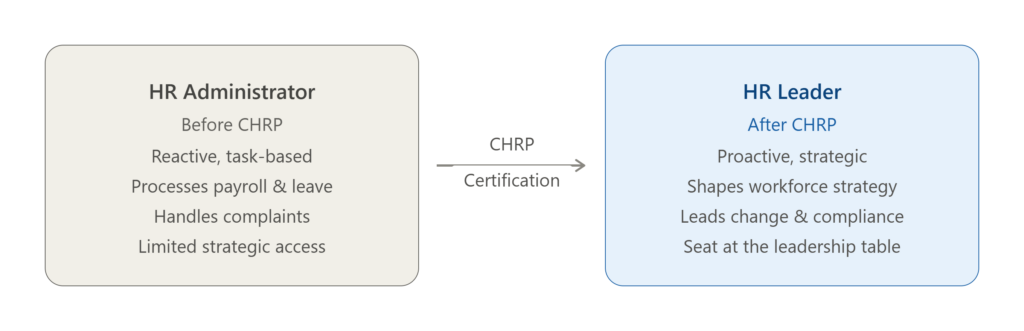
That shift in perspective is what separates HR administrators from HR leaders. And HR leaders are the ones who get a seat at the table when the tough decisions are being made.
Is CHRP Worth It? The Honest Answer
Yes — but only if you take it seriously.
CHRP certification is an investment of time, money, and intellectual effort. If approached as a box-ticking exercise, the returns will be minimal. But if pursued with genuine engagement — attending classes, doing the reading, applying concepts in your workplace, connecting with peers in the professional community — CHRP can be genuinely transformative.
The organisations that will thrive over the next decade are the ones that treat people as their most strategic asset. Managing that asset well requires professionals who understand not just the administrative mechanics of HR, but the human and organisational dynamics that determine whether a workforce performs, stays engaged, and weathers change.
That is the CHRP advantage. And it is real.
Ready to Take the Next Step?
Whether you are an HR practitioner looking to formalise your expertise, a recent graduate seeking to enter the profession with credentials, or a business leader who wants to build an HR function capable of leading real change — CHRP is the right place to start.
Visit our website sgb.ac.ke to learn about upcoming CHRP intake dates, fees, and registration requirements.
The workforce challenges of tomorrow will not wait. Neither should your professional development.