Phone: +254 700 524589 | +254 782 524589 Email: [email protected]
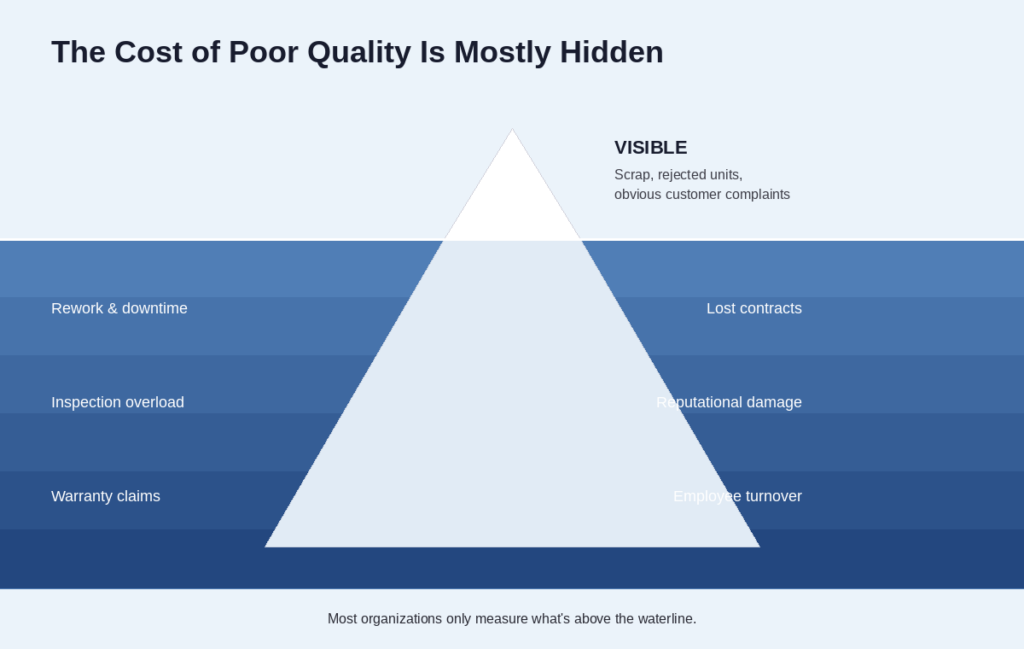
The cost of poor quality is the total expense a business absorbs when products, services, or processes fail to meet standards — covering rework, scrap, returns, customer complaints, lost contracts, and reputational damage. Most organizations never calculate this figure, which is exactly why it stays hidden, and why it keeps growing.
Quality experts often estimate that the cost of poor quality can run between 15% and 20% of total revenue in organizations without structured quality systems. For a mid-sized Kenyan manufacturer, service provider, or contractor, that’s not a rounding error — it’s the difference between healthy margins and a business quietly bleeding money every month.
What Poor Quality Actually Costs a Business
Poor quality rarely shows up as one obvious expense. It hides inside dozens of small, recurring costs that finance teams often misclassify as “normal operations.”
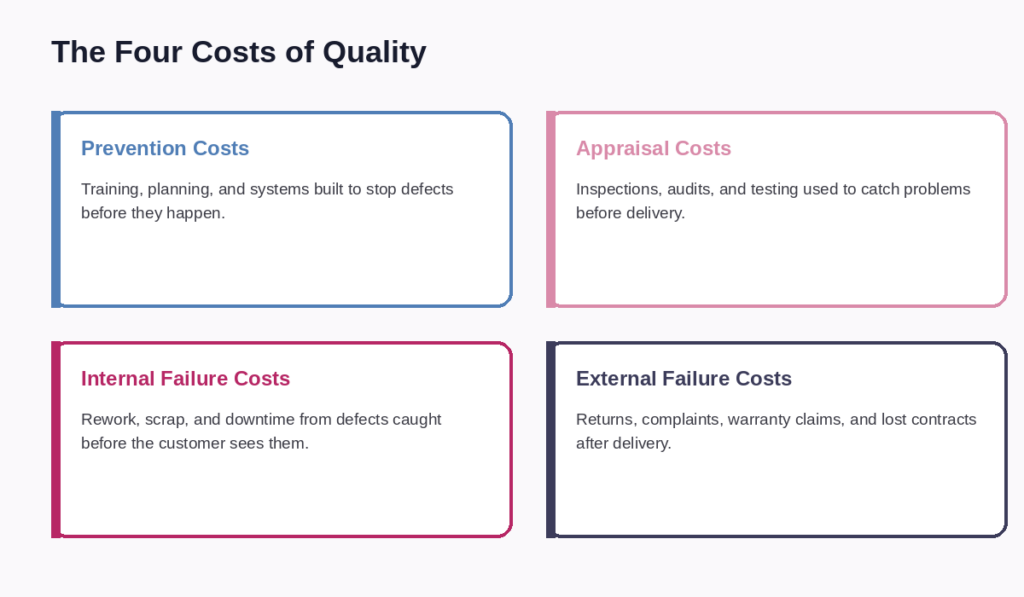
Internal failure costs happen before a product or service ever reaches the customer — scrapped materials, rework hours, downtime from equipment errors, and the staff time spent fixing avoidable mistakes.
External failure costs happen after delivery — customer complaints, product returns, warranty claims, refunds, and the legal or compliance exposure that follows a serious failure.
Appraisal costs are what a business spends trying to catch problems before they escalate — inspections, audits, testing, and supervision that often exist only because there’s no reliable system preventing errors in the first place.
Reputational cost is the hardest to quantify and the most expensive long-term. A single public quality failure — a delayed project, a defective batch, a service complaint that goes viral — can cost more in lost future business than every internal failure combined.
The pattern across all four categories is the same: poor quality is expensive precisely because it’s invisible until someone deliberately measures it.
Why Most Businesses Don’t See It Coming
Quality failures tend to get treated as isolated incidents — a bad batch here, a customer complaint there — rather than as symptoms of a systemic gap. Without a structured way to track defects, rework hours, and complaint patterns over time, leadership only sees the cost of poor quality after it has already compounded into a financial or reputational crisis.
This is where most organizations get the fix wrong. The instinct is to add more inspection, more supervisors, more sign-offs. But appraisal without data just adds cost on top of cost — it doesn’t address why failures keep happening in the first place.
How Data-Driven Quality Management Fixes It
Data-driven quality management replaces guesswork with evidence. Instead of reacting to complaints after the fact, organizations track quality metrics continuously and use that data to predict and prevent failures before they happen.
A practical data-driven quality system typically involves:
Defect tracking and root cause analysis — logging every failure with enough detail to identify the actual cause, not just the symptom, so the same mistake doesn’t repeat next quarter.
Statistical process control — using control charts and trend data to catch a process drifting out of specification before it produces a single defective unit.
Cost of quality reporting — quantifying prevention, appraisal, and failure costs side by side, so leadership can see exactly where money is being spent and where investment in prevention would pay off.
Customer feedback analytics — converting complaints, returns, and reviews into structured data that reveals patterns invisible in individual incidents.
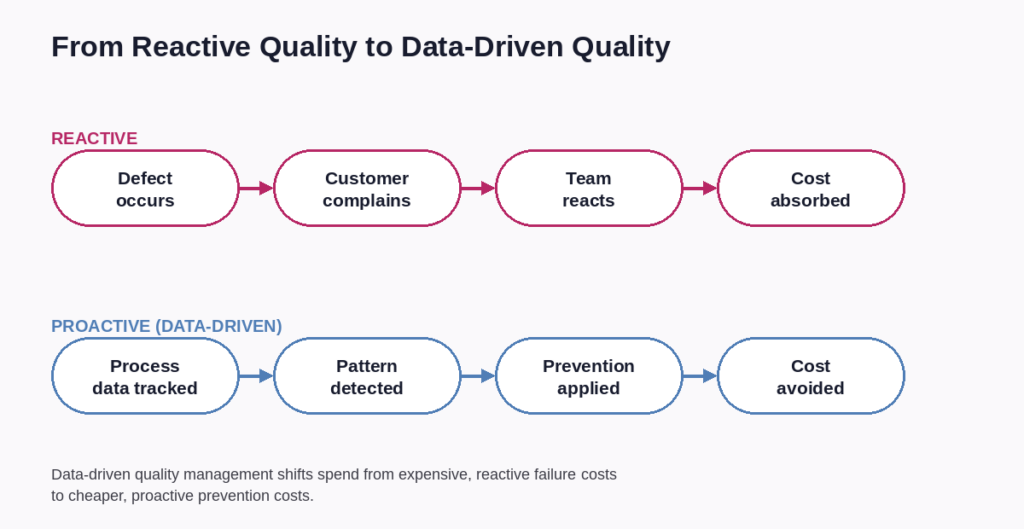
Organizations that build these capabilities don’t just reduce defects — they shift spending from expensive, reactive failure costs to cheaper, proactive prevention costs. That shift alone is usually where the financial recovery happens.
Turning This Into a Career and Organizational Skill
Understanding the cost of poor quality is one thing. Having the technical skill to build and run a data-driven quality system inside a real organization is another — and it’s a skill gap that’s increasingly visible across Kenyan manufacturing, finance, healthcare, logistics, and public sector institutions.
Two qualifications are built specifically to close that gap:
Certified Quality Professionals (CQP) equips you with internationally recognized quality management principles, root cause analysis, and continuous improvement methodologies used by quality professionals across industries.
Diploma in Quality Management (DQM) goes deeper into the operational and data side — process control, quality metrics, and the systems-thinking needed to actually run a quality function, not just understand the theory behind it.
Together, they prepare you to be the person in the room who can quantify the cost of poor quality, build the data systems to track it, and lead the fix — whether that’s in a factory, a bank, a hospital, or a government agency.
If your organization is still discovering quality problems through customer complaints instead of data, that’s the clearest sign the gap exists — and the clearest opportunity to close it.
Learn more about CQP and DQM at Traction School of Governance and Business. https://sgb.ac.ke/dqm/, https://sgb.ac.ke/cqp/
Traction School of Governance and Business is a TVETA, kasneb, and NITA-accredited training institution based in Nairobi, offering professional courses in governance, business, accounting, quality management & short ICT courses.